

From Sticky Weed to Super Herb: Cleavers' (Galium aparine) Benefits and Uses
Updated: May 27

It’s not unusual for me to return from a walk bringing with me various plants attached to the bottom of my jeans. One plant in particular has recently become a rather clingy friend, refusing to let go when I leave the garden. I am talking about cleavers (Galium aparine), also known as Sticky Willy, with small hooks on its leaves, stems and even its fruit which act like natural velcro. This characteristic allows the plant to attach itself to other plants (and my jeans!) to find support and grow up towards the light.
Aside from its hooks, Cleavers can be identified by observing its leaves which are organised in circles (« whorls ») around the square stem. The leaf shape is oblong to linear ending in a point and each leaf has a single central vein.
Cleavers may appear to be just another sticky weed, but in fact this super herb has a number of benefits and uses.
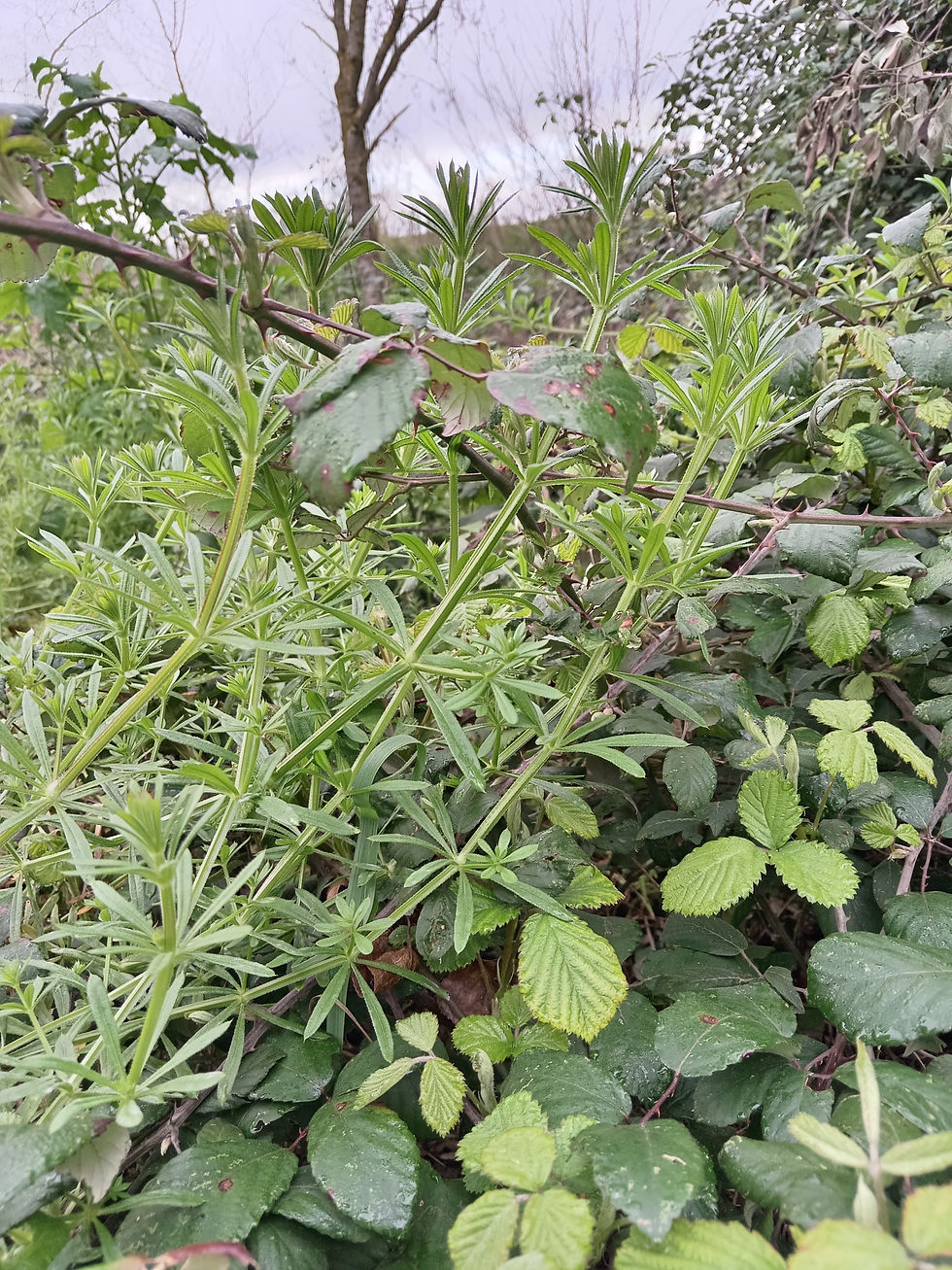
As a medicinal plant, Cleavers is effective in the decongestion of the lymphatic system, particularly in the case of swollen lymph glands. This enables the lymph to circulate more efficiently and improves the elimination of toxins.
As a diuretic plant, Cleavers acts on several levels to improve the function of the urinary system. The plant increases the production and elimination of urine, improves renal blood flow and reduces inflammation in the urinary tract.
Occasionally the skin, as a secondary elimination organ, can become overloaded with metabolic waste. In this case, cleavers act to reduce inflammation and improve waste elimination via the kidneys and the lymph. This can be helpful in treating inflammatory or dry skin problems, such as eczema, itching or psoriasis [1, 2, 3, 4, 5].
In cooking, the young shoots cut into small pieces can be eaten in salads or added to soups. The fruit can provide a substitute for coffee. This is less surprising than you think, when you learn that Cleavers is in the same family as the coffee plant (Coffea sp.), the Rubiaceae family.
Vegetable dyes use natural pigments in plants to colour natural fibres such as cotton, linen or wool. Cleavers roots can be used to make a pinky-red natural dye. It’s interesting to note that Cleavers is a member of the same family as Madder (Rubia tinctorum), well-known for its use as a dye plant.
Other traditional uses include bedding for mattresses (hence it’s nickname « bedstraw ») ; feed for geese (which gives rise to another nickname « goosegrass ») and children’s games involving throwing cleavers stems rolled into balls at other people to see how many will stick ! [6].
So, the next time cleavers attaches itself to you, remember that a sticky weed can sometimes be a super herb!

1. Sinclair, L et Holohan, C. Scotland’s Wild Medecine, Heal Scotland Books, 2021.
2. Hoffman, D. Medical Herbalism, Healing Arts Press, 2003.
3. Bone, K. et Mills, S. Principles and Practice of Phytotherapy, Elsevier, 2013.
4. Al-Snafi, Ali. (2018). Chemical Constituents and Medical importance of Galium aparine – a review. Indo Am. J. P. Sci, 2018; 05(03).
5. Talha, M. et al., (2025). The lymphatic lineage : unraveling the phytochemical and renoprotective potential of Galium aparine (Cleavers). TPM – Testing, Psychometrics, Methodology in Applied Psychology, 32(S7 (2025): Posted 10 October), 1057–1064.
6. www.plant-lore.com/cleavers/ consulté le 24.4.2026


